PTCOG-AO 2026: Empowering Access to Particle Therapy through Research, Education and Collaboration
A review by Sung Yong Park and Dayananda Sharma
The 6th Annual Conference of the Particle Therapy Co-Operative Group – Asia-Oceania (PTCOG-AO 2026) was held from 4–6 September 2026 at the Taj Fisherman’s Cove Resort & Spa in Chennai, India. Hosted by the Apollo Proton Cancer Centre, the meeting brought together the particle therapy community from across Asia-Oceania and beyond. The conference recorded more than 510 registrations, with 507 participants from 29 countries, including 116 international delegates, reflecting the growing scientific and clinical engagement with particle therapy across the region.
Three Days of Science and Education
The conference began with a dedicated Educational Day covering particle therapy physics, clinical commissioning, uncertainties, radiobiology, LET and variable RBE. Masterclasses explored practical challenges including range uncertainty, breast and prostate proton therapy, quality assurance and workflow optimisation.
The following two days featured Clinical, Physics and Biology tracks, alongside plenaries, symposia, debates, panels, masterclasses, quick updates and industry sessions. Discussions ranged from adaptive particle therapy, LET-guided treatment, proton arc therapy and motion management to biological optimisation, artificial intelligence and automation, upright particle therapy, multi-ion therapy and particle biology. The programme provided a multidisciplinary platform spanning clinical practice, medical physics, biology, AI and future research priorities in particle therapy.
A total of 115 abstracts were submitted across the three tracks, with 33 oral presentations selected. Six outstanding contributions were featured in the Best Paper Session. Twenty-five travel grants were awarded, supporting participation from across the region, particularly among young investigators.
A Strong Regional and Global Faculty
The meeting featured approximately 41 international academic and clinical faculty, including around 31 from the Asia-Oceania region and 10 from outside the region. This diverse faculty brought together expertise across clinical oncology, medical physics and particle biology, strengthening the meeting’s emphasis on regional collaboration and global scientific exchange.
The Dr. Prathap C. Reddy Annual Proton Oration
A major highlight was the 6th Dr. Prathap C. Reddy Annual Proton Oration, delivered by Prof. Marco Durante, Chair of PTCOG, on 5 September.
The Oration, titled “The Third Wave of Particle Therapy: From the Bragg Peak to Immune Preservation,” explored the evolution of particle therapy beyond its foundational physical advantages towards a broader understanding of biological effects and the potential importance of immune preservation.
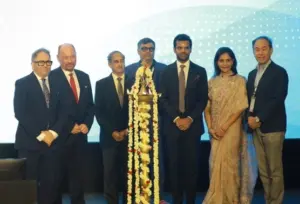
The Oration was followed by the formal Inaugural Ceremony, with Dr. A.K. Balasubrahmanian, Chairman of the Atomic Energy Regulatory Board (AERB), as the Guest of Honour, alongside senior leaders from PTCOG, PTCOG-AO and Apollo Hospitals.
Celebrating Scientific Excellence
The Best Paper Session showcased six selected contributions across clinical, physics and biology research.
The meeting recognised outstanding research through Best Oral Presentation Awards, with one award each in Clinical, Physics and Biology. The Best Poster Awards recognised one Clinical presentation and two Physics presentations, with two Physics presentations receiving the award following a tie.
Strengthening PTCOG-AO as a Regional Platform
Beyond the scientific programme, important organizational developments were discussed during the PTCOG-AO Steering Committee meeting.
PTCOG-AO was officially registered as a non-profit organisation in Korea in March 2026, providing a stronger organisational foundation for future educational, scientific and fundraising activities. The annual PTCOG-AO survey also continued to expand, with 35 participating institutions in 2026 compared with 25 in 2025, reflecting growing engagement across the Asia-Oceania region.
Looking ahead, Dr. Michael Wang of the National Cancer Centre Singapore was selected as the next PTCOG-AO Chair for 2027–2029, while Hefei Ion Medical Center in China was selected to host PTCOG-AO 2028. The community is also looking forward to PTCOG 65 and PTCOG-AO 2027 in Bangkok, which will provide further opportunities to strengthen collaboration between PTCOG and the Asia-Oceania particle therapy community.
Discussions also highlighted future opportunities for educational programmes, fellowships, collaborative research and joint scientific activities, reinforcing the role of PTCOG-AO as a regional platform connecting institutions and professionals across the field.
Beyond Science
PTCOG-AO 2026 also offered delegates a glimpse of Chennai beyond the conference halls. The programme featured a Santoor recital by Padma Shri Pandit Satish Vyas, sunrise yoga by the beach and a Gala Dinner.
On the final morning, delegates explored the heritage of Mahabalipuram, while two facility tours of Apollo Proton Cancer Centre provided an opportunity to experience a working proton therapy centre and learn from the host institution’s clinical environment.
Looking Ahead
PTCOG-AO 2026 brought together a vibrant multidisciplinary community representing 29 countries, with more than 510 registrations, 507 participants, 115 submitted abstracts and 25 travel grants. The meeting demonstrated the breadth and momentum of particle therapy research and clinical practice across Asia-Oceania.
More than a scientific meeting, PTCOG-AO 2026 provided a platform for exchanging ideas, presenting new research, building collaborations and connecting established experts with the next generation of particle therapy professionals. The meeting also marked an important stage in the continued development of PTCOG-AO as an independent regional organisation and as a bridge between the Asia-Oceania community and the global PTCOG network.
From education and scientific debate to the Proton Oration, awards, organisational developments, music, wellness and heritage, PTCOG-AO 2026 celebrated both the science of particle therapy and the community driving its future.
Chennai provided the setting for three memorable days of research, education, collaboration and shared experience. As particle therapy continues to expand across Asia-Oceania, PTCOG-AO is positioned to play an increasingly active role in promoting regional collaboration, education, research and access to particle therapy.