PTCOG-AO: A Preliminary Survey on Particle Therapy in Asia and Oceania (3rd)
By Chan Kyu Kim
The Asia-Oceania Particle Therapy Co-Operative Group (PTCOG-AO) presented the results of its survey on the current status of particle therapy in the Asia-Oceania region at PTCOG-AO 2026, held in Chennai, India, from September 4 to 6.
Entitled “A Preliminary Survey on Particle Therapy in Asia and Oceania: Status and Sustainability,” the survey aims to assess and share information on clinical practice and system operations at particle therapy centers affiliated with PTCOG-AO, while also establishing a regional database to support the future expansion of particle therapy across Asia and Oceania.
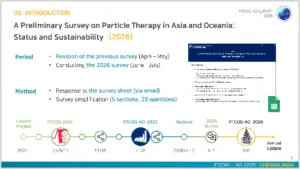
Launched in 2024, the survey has been conducted annually and reached its third edition in 2026, following the surveys carried out in 2024 and 2025.
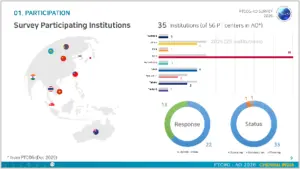
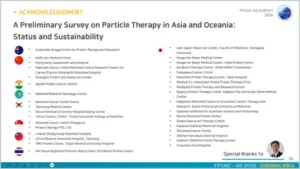
The 2026 survey was conducted online via email from June to July and included responses from 35 institutions across 8 countries. Participating institutions represented every country in the Asia-Oceania region currently providing particle therapy and accounted for approximately 60% of the particle therapy centers in operation across the region.
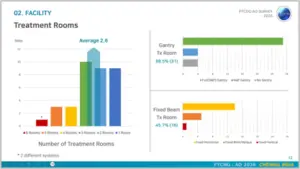
The survey included both proton therapy and carbon-ion therapy centers, with participating institutions ranging from long-established centers that have been providing particle therapy since as early as 1994 to newer centers currently installing treatment systems and preparing to begin clinical operations.
The survey content was updated based on the experience and feedback from the previous two surveys. The survey sheet was organized into five main sections: Basic Information, Treatment Facility, Personnel, Planning & Treatment, and Insurance.
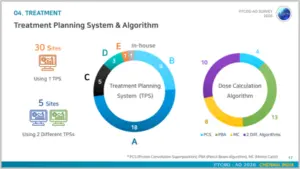
Through this survey, we were able to gain a broader understanding of the current status of particle therapy in the countries across Asia and Oceania, including trends in patient growth, differences among countries, and future plans. The survey also provided a foundation for building a regional dataset to support future collaboration and discussion.
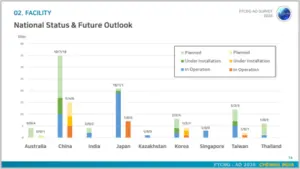
The survey results are being shared online with the participating institutions and are expected to serve as an important reference for future policy development, the establishment of new particle therapy centers, and strengthened collaboration across the Asia-Oceania region.
Finally, the Asia-Oceania region is home to approximately 60% of the world’s population. Considering the current availability of radiotherapy and the growth potential of individual countries in the region, particle therapy is expected to continue expanding actively in the coming years.
To reflect the ongoing changes in particle therapy across Asia and Oceania, this survey project is planned to be updated annually. In addition, the survey results are being prepared for publication in PTCOG’s International Journal of Particle Therapy(IJPT) in the near future.
We look forward to sharing the published results with the PTCOG community.