News from the Industry
RaySearch: an enhanced support for particle therapy RE-irradiation planning and evaluation.
With the upcoming RayStation release, RaySearch introduces a new investigational (not CE-marked or FDA-cleared, thus not available for clinical use) functionality for reirradiation planning and evaluation. The new framework includes cumulative dose assessment based on deformable image registration and equi-effective dose in 2 Gy fractions (EQD2). It enables ROI‑specific EQD2 parameters, including the modeling of partial tissue recovery between treatment courses.
Because reirradiation is fundamentally constrained by cumulative dose to organs at risk (OARs), particle therapy is particularly well suited for these scenarios. Its ability to reduce unnecessary dose to previously irradiated tissues helps mitigate the risk of severe toxicity, even in complex reirradiation cases. RayStation supports reirradiation planning across modalities, including all currently supported delivery techniques for proton, helium, and carbon ion therapy, regardless of the modality used in prior treatments.
To further strengthen the potentiality of particle therapy in reirradiation, RayStation enables robust optimization of cumulative EQD2, allowing direct consideration of prior OAR doses in the optimization process. This can be combined with the conventional robust optimization for the reirradiation target, accounting only for the dose contribution from the current plan. Together, these capabilities support a balanced trade‑off between cumulative OAR doses and target coverage.
We are committed to continue driving innovation in reirradiation and supporting the next generation of particle therapy solutions. Join the community at our upcoming RaySearch Particle Therapy User Meeting, hosted in conjunction with PTCOG, to continue the discussions on innovation in particle therapy, and come by our booth at PTCOG to explore our reirradiation solution and more. Visit our PTCOG 2026 page for more information.
C-RAD: SGRT meets the clinic at the Proton Center of Arkansas
The Proton Center of Arkansas at the University of Arkansas for Medical Sciences (UAMS) has completed clinical commissioning of its IBA Proteus One proton therapy system, making it one of the first Proteus One centers in the United States to include C-RAD surface guided radiation therapy (SGRT) as part of its clinical program.
C-RAD’s Catalyst+ PT is a dedicated SGRT solution for proton therapy environments, supporting precise patient positioning and real-time motion management throughout proton beam delivery. It integrates with IBA systems to deliver consistent surface guidance across the treatment workflow.
“Successful SGRT implementation is about more than technology. It is about building efficient clinical workflows that support precision and consistency in proton therapy,” states Elizabeth Edwards RT(T), Team Lead CAS Americas & Clinical Applications Specialist.
C-RAD congratulates the entire UAMS team on this important milestone and looks forward to supporting their program as they bring precise, patient-centered proton therapy to the people of Arkansas, United States.
C-RAD SGRT is integrated across major global proton delivery platforms. Learn more: https://c-rad.com/proton-solutions
P-Cure:
Founded in 2007, P-Cure aims at democratizing Proton Therapy, offering the most compact FDA-cleared solution for treating cancer patients. P-Cure’s comprehensive system enables the planning and treatment of patients with Proton Therapy in both supine and seated positions, tailored to fit linac-like vaults within existing or new radiation therapy centers.
Operating globally with production, service, and R&D platforms in the US, Israel, and China, P-Cure collaborates closely with healthcare providers supporting them across all stages, from installation to operation.
P-Cure is committed to ushering in a new era of life-saving technology accessible to all oncology centers and their patients.
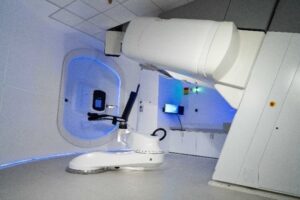
Terapet: Towards Integrated In Vivo Verification in Upright Particle Therapy
A fully integrated workflow combining treatment planning, delivery, and in vivo verification in particle therapy?
Terapet, Leo Cancer Care and RaySearch Laboratories are collaborating to find the perfect recipe.
The approach focuses on PET-based verification performed directly in treatment position, immediately after irradiation. This enables preservation of geometrical consistency with minimal activity decay and washout effects and supports a direct comparison between planned and measured activity distributions.
By linking treatment planning with RayStation, upright delivery, and PET-based measurement, the collaboration aims to provide independent and quantitative verification of treatment delivery, while supporting early detection of deviations.
This integrated framework reflects ongoing efforts toward more patient-specific, data-driven workflows in particle therapy, with the potential to support future adaptive treatment strategies.