R and D Progress on China’s First Light Ion Therapy Device
The successful development of China’s first light ion therapy device marks a major breakthrough in the domestic high-end radiotherapy equipment technology. The therapy device, independently developed and manufactured by CAS Ion Medical Technology Co., Ltd. (CASHIM), has been successfully installed in the commissioning factory of its Hangzhou R&D center. Having completed the critical equipment installation and system joint commissioning, it will proceed with the critical beam commissioning and performance verification.
The device, designated as model HiTS 200 (Hybrid Ion Therapy System, Energy: 230MeV/u), features advanced beam output capabilities in its design. It can deliver various ion beams, including protons, helium ions, and carbon ions, for radiotherapy research and application. Among these, the ranges of proton and helium ion beams reach 30 cm, which can effectively cover solid tumors in the vast majority of human body parts and enable the treatment of deep-seated lesions. In contrast, the carbon ion beam has a range of 10 cm; with its unique radiobiological advantages (such as a higher relative biological effectiveness), it is particularly suitable for the precision treatment of tumors in complex regions such as the head and neck.
Furthermore, this device features its wide application in the field of medical physics research by providing proton beams with energies exceeding 350 MeV, enabling the advancement of novel proton computed tomography (proton CT) studies. Proton CT technology holds the potential to deliver more precise dose calculations and detailed anatomical information of patients, which is of great significance for enhancing the accuracy of radiotherapy planning. The successful advancement of this device shall serve as a vital experimental platform and offer solid technical underpinning for the research and clinical translation of advanced particle therapy technologies in China.
The layout of the light ion therapy device is illustrated in the figure below. It adopts the configuration of “a linear injector + a synchrotron + three treatment rooms (one horizontal fixed-beam treatment room and two treatment rooms equipped with 360° rotating gantries)”. The device primarily consists of an ECR ion source, a linear injector, a medium-energy beam transport system, a synchrotron, a high-energy beam transport system, and treatment terminals. The treatment terminals include the treatment control system, image-guided system, patient support system, laser positioning system, treatment planning system, and oncology information system, among others.
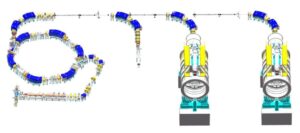
The device is designed with two ion sources, both utilizing ECR (Electron Cyclotron Resonance) technology. One serves as a proton source, delivering proton beams, while the other functions as a heavy ion source, providing beams of ions such as helium and carbon.
The linear accelerator employs an RFQ (Radio Frequency Quadrupole) accelerator as the front end of the injector. Its primary role is to accelerate low-energy ion beams from 10 KeV/u at the exit of the low-energy beam transport system to 0.6 MeV/u. This is followed by an APF (Alternating Phase Focusing) drift tube accelerator, which further accelerates the ion beams to 4 MeV/u.
The synchrotron adopts a hexagonal symmetric structure with a conventional magnet design, featuring a magnetic rigidity of 4.66 Tm and a circumference of less than 40 meters. Beam injection is achieved through a multi-turn injection method, utilizing bump magnets to create localized orbit bumps. Driven by the septum magnet and electrostatic deflector, the injected beam is directed into the acceptance region of the ring. With the beam being continuously injected, the intensity of the bump magnet is gradually reduced until the horizontal acceptance of the entire ring is fully filled, thus completing the beam injection process. For acceleration, the longitudinal high-frequency phase is set to zero, and the voltage is gradually increased to capture the continuous beam into bunches. Subsequently, the RF frequency phase is gradually raised, enabling the synchronous particles to gain energy through the longitudinal electric field, thereby achieving the beam acceleration. During the acceleration process, it is essential to ensure that the rise rates of the RF frequency, the magnetic field of the synchrotron, and the magnetic rigidity of the beam remain synchronized. The beam extraction adopts the RFKO method. Specifically, the working point of the synchrotron is set near Qx / Qy= 1.68 / 1.88. Then, the intensity of the sextupole magnets is increased to induce distortions in the transverse phase space of the beam. Finally, a transverse excitation is applied to the beam, which leads to an increase in its emittance and thus achieves the beam extraction.
The rotating gantry adopts a truss structure, and its magnets are of the hybrid superconducting magnet type. This design further reduces the overall size and weight of the gantry, which now has a total weight of approximately 100t, a length of 7m, and a rotational radius of 5.5m.
(I) Key Technical Specifications of the Light Ion Therapy Device
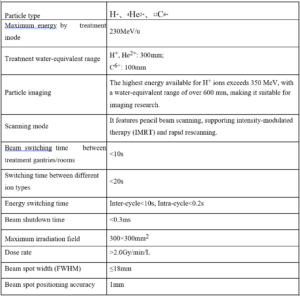
(II) Technical Features of the Light Ion Therapy Device
The light ion therapy device integrates three types of ion beams—proton (H+), helium ion (4He2+), and carbon ion (12C6+)—significantly surpassing the efficiency of single-ion therapy systems. With millimeter-level positioning accuracy and the unique energy release characteristic of the “Bragg Peak,” it enables precise “targeted destruction” of tumor lesions, minimizing damage to healthy tissues. The device incorporates several advanced technologies, including rapid switching between multiple ion types, single-cycle energy variation, fast rescanning, Flash dose delivery (>100 Gy/s), a 360° rotating treatment gantry, arc therapy, and multi-ion hybrid treatment (LET painting).
The synergistic application of the three ion types significantly expands the range of indications for tumor therapy. Among them, proton beams offer excellent normal tissue protection, making them particularly suitable for cases requiring high tissue preservation, such as pediatric tumors and tumors adjacent to sensitive organs. Carbon ion beams, leveraging their high linear energy transfer (LET) and high relative biological effectiveness (RBE), can effectively tackle resistant tumors that are insensitive to X-rays or proton beams. Helium ions exhibit intermediate characteristics: they combine lower lateral scattering and range straggling with a relatively high RBE. This not only reduces dose leakage at the edges of the irradiation field, lowering the risk of damage to healthy tissues, but also generates enhanced biological effects in deep-seated target areas without the severe secondary fragmentation issues associated with carbon ions. This makes helium ions suitable for treating composite tumors at shallow, medium, and deep tissue depths. Through the flexible combination of these three ion types, “tailored” radiotherapy plans can be customized for different lesion types and locations, enabling precise anti-cancer treatment.
Compared to single-ion therapy systems, this device allows for multi-ion combination therapy in treatment planning. Multi-ion therapy, combined with LET painting technology, alternates the use of protons, helium ions, and carbon ions within the same treatment plan. By leveraging the differences in LET among these ions, it further optimizes LET distribution on the basis of dose optimization, allowing both dose and LET to be adjusted according to therapeutic needs. Through LET distribution optimization, high LET can be precisely targeted to specific areas of the tumor (e.g., hypoxic regions), enhancing tumor control rates while protecting healthy tissues. Meanwhile, in cases with complex anatomical structures, LET painting can be employed to irradiate target areas adjacent to organs at risk using low-LET radiation, thereby reducing the risk of exposing these critical organs to high-LET rays to some extent.
(III) R&D Progress on China’s Light Ion Therapy Device
In December 2024, the multi-ion linear injector was successfully developed and met performance standards.
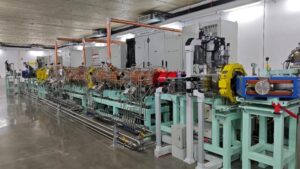
In November 2025, the prototype of the light ion therapy system was successfully developed, with equipment installation and commissioning completed, followed by the beam commissioning soon.
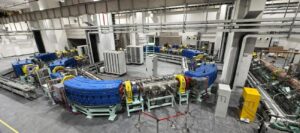
To fulfill the experimental research requirements for helium ion beams, one horizontal experimental terminal has been set up in the commissioning factory, equipped with a horizontal treatment gantry, along with auxiliary devices such as a robotic arm treatment couch, orthogonal digital radiography (DR), and laser positioning systems.