Particle Therapy MasterClass PTMC
The Particle Therapy MasterClass (PTMC) project celebrated its fifth anniversary in 2025. Since its inception, a total of 70 institutes from 38 countries have performed the PTMC at least once, providing participants with the opportunity to familiarise themselves with methods of treating cancerous tumours using X-rays, protons, carbon ions and, more recently, helium ions. Building on this success, the PTMC-2026 season will begin on 11 February celebrating the “International Day of Women in Science”. The 55 institutes that have already registered are actively preparing to welcome young participants from their regions over the next six weeks. The organising institutes’ tutors engage with students, motivating them with lectures and laboratory visits, and assisting them through an unforgettable hands-on experience.
The PTMC was initially developed within the IPPOG (International Particle Physics Outreach Group) International MasterClasses (IMC) programme, which addresses high school students. However, it has evolved within the EU-funded HITRIplus project (https://www.hitriplus.eu/)expanding its scope and reach to include early-stage researchers and professionals.
In its original format, the PTMC is a full-day activity combining many pedagogical elements. In the morning, lectures combined with videos, animations and laboratory visits lay the groundwork for the hands-on experience in the afternoon. Participants use the open-source matRad treatment planning software, developed by DKFZ for educational and research purposes, to create plans for various cases, thereby gaining an intuitive understanding of the differences between X-rays and hadrons. They then present their results during a video conference with hadron therapy experts, who also offer an online tour of their facilities. The day concludes with a quiz designed to help participants consolidate what they have learnt in a fun way. Indeed, a master’s thesis based on rigorous methodology demonstrated that students learn even through one-day events.
The HITRIplus full week Heavy Ion Therapy MasterClass HITM school was structured based on these concepts and format. It was the first event organized after the project’s approval; it was held online due to the pandemic and attracted 1050 participants from all over the world. Subsequently, dedicated sessions were included in all online HITRIplus schools to promote sustainability and to enable participants to perform PTMCs at their home institutes and in their own countries. These activities were complemented by a full-day in-person Treatment Planning MasterClass event for university students and professionals following the HITRIplus Hadron Therapy Workshop in Thessaloniki in October 2024. This provided an additional opportunity to validate the concept, with ‘trained trainers’ acting as tutors.
Admittedly, the start-up of the PTMC was challenging. After its development phase in early 2019, which included a local test at GSI in February and a pilot in April involving CERN, DKFZ and GSI, the PTMC was approved and integrated into the International MasterClasses programme. The first PTMC session took place on the 2nd of March 2020, in Mexico, which was when the first cases of the novel Coronavirus (Covid-19) started to spread. Consequently, all the rest of the 2020 sessions were cancelled. It was then adapted for online delivery for the 2021 season, reaching 1,500 students from 37 institutes in 20 countries immediately. A brainchild of Yiota Foka from GSI, the project received ample support from the community and was soon established. The PTMC web pages provide all the necessary material and documentation in different languages based on worldwide contributions. The PTMC brings scientific methods into classrooms, highlighting the impact of fundamental research for the benefit of society and focusing on the treatment of cancer with charged particle beams and their advantages.
To mark its fifth anniversary, an online event was held in March 2025, celebrating the dedication of organizers and tutors worldwide and highlighting the PTMC’s impact. In addition, a special PTMC session was hosted at CERN, and a full-day PTMC session for teachers was organized at Oxford, both in person in June 2025. These activities were complemented by an online PTMC mini-session integrated into a full-week course organized by ESF Sha Tin College in Hong Kong, which was also joined remotely by students from several other Chinese schools. The PTMC 5-year celebrations concluded in December with special sessions in Mexico, where they were first performed. These sessions addressed teachers, university staff, and students. Details were published Accelerating News in the summer of 2025.
The PTMC continues to expand and develop, and one of its main advantages is its flexibility. Its format allows organizers to adapt it according to their context and facilities and adjust the level according to the audience, thereby promoting inclusion and diversity — especially in countries where students have never had the opportunity to engage with such topics before. It provides an opportunity to demonstrate the direct impact of fundamental research in advancing cancer treatment — a topic that is not usually included in curricula in most countries.
Many local organizers shared examples of students who developed an interest in scientific careers and a desire to contribute to society and the fight against cancer after participating in the PTMC. Several students confirmed that the program motivated them to pursue studies in science, technology, engineering, and mathematics (STEM), and gave them a perspective for attractive career paths and interesting jobs that have a tangible impact on society. With an average of around 60% of participants being young women each year, the initiative also plays a significant role in promoting gender diversity in STEM subjects. Most importantly, university assistant tutors take the opportunity to delve into the topic with the support of the provided PTMC online training and recorded materials, and many of them go on to pursue related careers.
The PTMC activity was developed by GSI in collaboration with CERN and DKFZ. GSI coordinates and moderates it, with contributions from many collaborators, including CNAO and numerous HITRIplus and I.FAST colleagues.
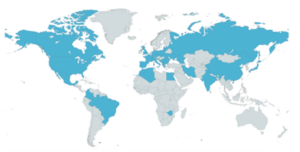
The world-map shows the countries where the PTMC was held during these five years.