The First Clinical Physics Training Workshop on Proton and Heavy Ion Therapy in China
The first training workshop dedicated to clinical physics on proton and heavy ion therapy was held at Hefei Ion Medical Center (HIMC) in Hefei, China from September 18 to 22, 2025. The five-day program featured a comprehensive curriculum covering the entire chain of knowledge and skills on particle therapy, starting from fundamental physics and radiobiology of particle beams, treatment equipment principles, to treatment planning and optimization, image guidance, motion management, radiation safety, regulatory affairs, as well as the concept/practices of quality control (QC) and quality assurance (QA). It attracted active participation from clinical physicists, radiation oncologists, and therapy technologists from existing and developing particle therapy centers across China, as well as R&D engineers from related industries.
The program included three days of lecturing and the faculty comprised of leading experts in the field of particle therapy from respected institutions both in China and abroad, including Tsinghua University, Chinese Academy of Medical Sciences, Institute of Modern Physics, Shanghai Proton and Heavy Ion Therapy Center, Wuwei Heavy Ion Therapy Center, Shandong Cancer Hospital, Guangzhou Concord Cancer Hospital, University of Science and Technology of China, University of Florida Proton Therapy Institute, New York Proton Center, etc. Each lecture was immediately followed by a study session led by HIMC physicists with presentations and discussions focusing on the clinical applications of the key principles presented in the lecture.
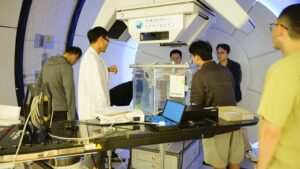
The highlights of the program were the practicum sessions packed in the remaining two days, intended to establish a complete learning cycle from theory to practice. The trainees were divided into small groups (4-5 per group) and rotated through multiple sessions in two modules: “Treatment Planning” and “Treatment/Measurement,” under the guidance of HIMC physics staff. In treatment planning, each trainee was provided with a TPS workstation so that they could work individually on cases in major treatment sites including head & neck, thoracic, abdominal, pelvic, breast, and pediatric craniospinal irradiation (CSI), while exploring the skills of field placement, robust optimization and plan evaluation, etc. For the treatment/measurement module, all three gantry treatment rooms at the center were setup to run parallel practicum sessions for trainees to gain firsthand experience with core clinical physics tasks and techniques. These included, for example, treatment with respiratory gating, beam data acquisition (e.g., spot size, spot symmetry, integral depth dose), daily/monthly QA, and image-beam coincidence verification, patient specific QA, etc. The small-group format ensured ample hands-on opportunities for every participant, allowing them to get a real feel of clinical physics practices. The trainees have given highly positive feedback on the practicum sessions, noting that this immersive experience significantly enhanced their understanding of the entire workflow of proton and heavy ion therapy with deeper understanding of the technologies and clinical challenges.
Particle therapy is developing rapidly in China with 10+ centers in clinical service now and nearly 50 more either under construction or in planning. The shortage of qualified clinical physicists is a serious problem and will be more so in the near future. Training workshops dedicated to clinical physics, like this one held at Hefei Ion Medical Center, could help provide short- and long-term reliefs to the problem. By combining systematic theoretical lecturing and matched practicum sessions, the program provided an invaluable open and pragmatic learning platform for participants. It has contributed to nurturing a cohort of professionals with solid theoretical knowledges and practical skills for proton and heavy ion therapy community in China.
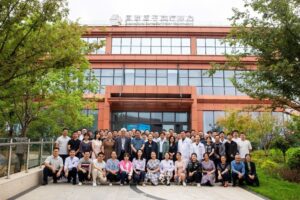
The training program was co-organized and supported by the China Association for Medical Devices Industry, Hefei Ion Medical Center of the First Affiliated Hospital of University of Science and Technology of China (USTC), the Tsinghua Advanced Particle Industry Innovation Platform, and Beijing Huaqing Particle Technology Co., Ltd.